PSHE (including RSE) at Hatfield Peverel Infant and Nursery School
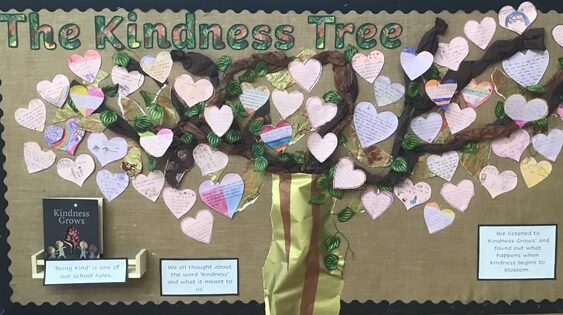
The children listened to ‘Kindness Grows’ by Britta Teckentrup and gave examples of how they can show kindness for a whole school display. They found out what happens when kindness begins to blossom.

Children have regular lessons about ‘Zones of Regulation’ and Year One children have enjoyed drawing their own worry monsters. Some even had names!
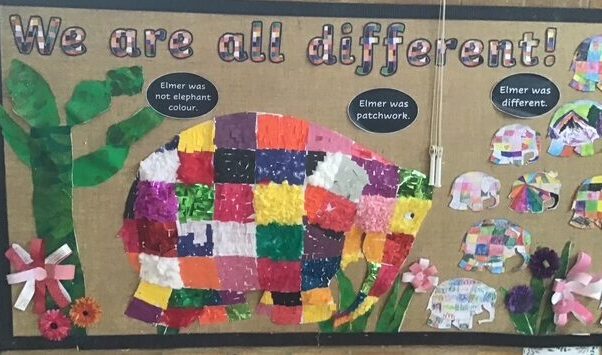
The whole school learnt about Elmer the elephant and how he was different to all the other elephants. He was different. He was unique. The whole school decorated an Elmer and made a whole school display in the hall.
PSHE and RSE
Context and Legal Framework
All schools must provide a curriculum that is broadly based, balanced and meets the needs of all pupils, as stated under section 78 of the Education Act 2002. Although PSHE education was previously a non-statutory subject, its status changed in 2020, when both health education and relationship education became statutory. This followed The Children and Social Work Act 2017, which included legislation making Relationship and Sex Education (RSE) compulsory in schools. For primary schools, only the ‘Relationship’ element of RSE was made compulsory.
From September 2026, schools are required to teach a new framework for Relationship, Sex and Health education (RSHE). At Hatfield Peverel Infant and Nursery School, we are fully prepared for the new framework and have ensured that our PSHE (including RSE) curriculum is fully in line with updated guidance.
Although not currently a National Curriculum subject in its own right, Citizenship plays an essential role in our PSHE curriculum, teaching children the important role they play in their community and wider society. In 2011, the government defined British Values as democracy, the rule of law, individual liberty, mutual respect and tolerance of different faiths and beliefs. We promote these values through our own school values, PSHE curriculum and enrichment activities.
RSE Policy development, review and consultation
As part of the statutory requirements for Relationships, Sex & Health Education (RSE), all primary schools must have in place a written policy for Relationships and Sex Education. Schools should ensure that the policy meets the needs of pupils and parents and reflects the community they serve. At Hatfield Peverel Infant and Nursery School, our current RSE policy is due to be reviewed in consultation with staff, governors and parents/carers. The process of consultation for this involves the draft policy being shared with all stakeholders and an opportunity given to respond. Additionally, staff will discuss aspects of the policy in an age-appropriate way with pupils and seek their views. This could be through pupil voice opportunities and PSHE lessons.
Following consultation, the school will review feedback and identify any themes or concerns, decide whether changes to the RSE policy or approach are needed and then publish the updated policy and make it fully accessible on the school website.
The consultation period will be completed Autumn 2026.
Parent Zone
At Hatfield Peverel Infant and Nursery School, we are always keen to involve parents and carers in their child’s education and to work in close partnership. Our school follows KAPOW for our PSHE (including RSE) scheme and KAPOW provide a designated ‘Parent Zone’, which all parents and carers can access. The purpose of the Parent Zone is:
- Find answers to common questions about RSE & PSHE.
- Understand what is included in the Kapow Primary RSE & PSHE scheme.
- Learn about parents’ rights in relation to RSE & PSHE, particularly around sex education.
- Understand the benefits of RSE & PSHE and how they can support your child’s learning.
To access Parent Zone, please use the following link.
https://www.kapowprimary.com/subjects/rse-pshe/curriculum/rse-pshe-parent-information/
INTENT – What we are teaching in PSHE and RSE
At Hatfield Peverel Infant and Nursery School, we are committed to providing a board and balanced curriculum that promotes children’s spiritual, moral, cultural, mental and physical development and prepares them for the opportunities, responsibilities and experiences of later life. It provides an opportunity to give every child an equal opportunity to develop the skills and knowledge they need to thrive now and in the future. PSHE education at our school incorporates RSE helps prepare pupils to navigate the ever-changing, complex modern world.
We believe that a high quality PSHE education helps our pupils develop into well-rounded members of society, who can make a positive contribution to their community. Our curriculum covers key areas which will help children to make informed choices now and as they grow, around their health, safety, wellbeing, relationships and financial matters.
Aligned with our four school ERIC values: Effort, Respect, Independence and Communication, our curriculum enables children to:
- Understand and regulate their emotions and behaviours.
- Build and sustain positive relationships.
- Develop a strong sense of self-worth and purpose
- Recognise and celebrate difference.
- Understand rights, responsibilities and the importance of consent (permission), safety and equality.
- Understand and adapt to changes as they grow and know how to stay physically and mentally healthy.
Our curriculum supports our robust safeguarding culture, addressing issues including boundaries and consent, personal safety (including online) and mental wellbeing. It also reflects British Values and contributes towards pupil’s spiritual, moral, social and cultural (SMSC) development. Please refer to our British Values page on our website.
IMPLEMENTATION – How we are teaching PSHE and RSE
Our PSHE curriculum is delivered through the KAPOW spiral curriculum, with additional, aligned learning opportunities and cross-curricular links found, where appropriate. A spiral curriculum ensures key concepts are revisited and deepened over time, ensuring learning is age-appropriate, meaningful and secure. The Kapow Primary RSE & PSHE scheme covers the full breadth of learning pupils need to stay healthy, safe and prepared for life. This includes:
- Personal
- Social
- Health
- Economic
- Relationship.
- Citizenship
The scheme is organised into strands and key areas to ensure a broad and balanced curriculum. The strands show how pupils’ personal and social skills develop over time. They are drawn from the EYFS statutory framework, with the addition of critical thinking. They run through every key area, helping pupils learn to regulate their emotions, manage themselves, build positive relationships and think critically. This allows them to make thoughtful, informed choices as they grow. Together, the strands and key areas help pupils revisit important ideas over time, building their confidence and understanding in a structured way. The strands run from Reception through to Year 2.
STRANDS
Self-regulation
Learning to recognise and manage pupils’ emotions, thoughts and behaviour so they can respond calmly and make considered choices.
Managing self
Learning to take increasing responsibility for pupils’ own behaviour, routines and decisions to support their wellbeing and independence.
Building relationships
Learning how to form positive, respectful relationships by communicating kindly, understanding others and setting healthy boundaries.
Critical thinking
Learning to ask questions, consider different viewpoints and make informed, thoughtful decisions in a world where information is not always reliable.
KEY AREAS
Learning is organised into seven key areas:
My healthy self
Learning how to look after their mental and physical health and make choices that support their wellbeing.
Connecting with others
Learning how to build positive relationships, communicate with respect and understand the importance of kindness and boundaries.
The online world
Learning how to use the internet safely, recognise risks and behave responsibly when communicating or accessing information online.
Citizenship (non-statutory)
Learning how to take part in their communities, understand rules, rights and responsibilities, appreciate diversity and fairness and develop early financial literacy.
Staying safe
Learning how to recognise risks, respond safely in different situations and seek help when something feels wrong or unsafe.
Growing up
Learning about the changes that happen as they grow, including puberty and developing bodies and how to manage these changes with confidence.
Health protection
Learning how to prevent illness, manage basic first aid and understand how hygiene, vaccines and healthy habits help keep people well.
Key areas ensure all statutory content is covered. Together, the strands and key areas help pupils revisit important ideas over time, building their confidence and understanding in a structured way.
Further information on our PSHE (including RSE) curriculum can be found in the documents provided.
INCLUSION AND DIVERSITY
A bespoke set of illustrated characters is embedded throughout Kapow’s RSE and PSHE scheme. The characters reflect the diversity of children in UK primary schools through a range of appearances, family structures, cultural backgrounds, experiences and additional needs. They help children see both themselves and others positively represented within the curriculum. Each character is presented as a unique individual rather than as a representative of a particular group or community. This helps pupils to recognise and value the diversity of experiences and perspectives that exist within and across communities
EYFS
Our RSE & PSHE scheme aligns with the statutory EYFS guidance. Key themes and skills introduced in EYFS (Reception) are revisited and developed further in KS1, ensuring continuity and progression. This transition is aided by the continuity of learning created by the key areas, which run from EYFS to Year 2.
Further information can be found in the EYFS Policy and related curriculum documents.
ERIC
ERIC the elephant is our school mascot who helps pupils develop their learning skills across the curriculum. ERIC is embedded within the school both in and out of the classroom.
His name stands for:
- EFFORT (don’t give up, do your best and try hard, take part, improve your skills)
- RESPECT (say please and thank you, be a nice person, use good manners, do what the grown-ups ask you)
- INDEPENDENCE (look after your own things, think first, try on your own, find your own equipment)
- COMMUNICATION (look who is talking, wait your turn, listen carefully, talk to each other)
Zones of Regulation
The Zones of Regulation is a framework, created by Leah Kuypers, designed to “foster regulation and emotional control.” The programme aims to teach children about self-regulation by categorising all the different ways we feel and states of alertness we experience into four concrete-coloured zones. It provides strategies to teach pupils to become more aware of and independent in controlling their emotions and impulses, manage their sensory needs, and improve their ability to problem solve conflicts.
What Are the Zones?
The zones are a self-regulation approach to behaviour that categories all the different ways we feel into different colours, which helps children to identify the way they are feeling.
Emotions in all of the zones are natural to experience, but by using the framework children will learn how to recognise and manage feelings from all zones, as well as further understand how those around them may be feeling.
It provides strategies to help children understand how they can control their emotions and improve their ability to problem solve conflicts. It enables children to move towards independent emotion regulation. This is a lifelong skill that they will not only be able to transfer to future educational settings but also use in their relationships and situations they encounter outside of school.

Philosophy for Children (P4C)
We use Philosophy for Children (P4C) approach to teaching and learning, to help children to develop into effective, critical and creative thinkers and to take responsibility for their own learning in a caring and collaborative way. We do this by providing practical ways of developing good thinking, questioning and communication skills. We use a variety of stimuli to aid discussion including use of stories, pictures, film clips, ‘would you rather’ questions to encourage discussions. It can often be used in conjunction with topics we are covering. We develop the children’s skills of active questions, active listening, giving reasons and making connections.
With experience, children’s questions get deeper and more thoughtful. The children’s discussions become more disciplined and focused yet, at the same time, more imaginative.
We find this approach helps to develop creative and critical thinking skills, encourages children to care about what others say, to develop the ability to recognise differences and to explore their differences collaboratively.
SMART thinking
SMART thinking provides a focused and systematic way for children to develop their own feelings, thoughts and behaviours and encourages them to make links between them. SMART thinking is taught using a wide variety of resources including pictures and cartoons showing scenarios. Restorative conversations are rehearsed in line with our Relationship and Behaviour Policy. The process is developed purely through verbal scenarios and discussions.
The main focus of each session is to develop the principles behind successful interpersonal social thinking skills:
STOP, THINK, CHOOSE, DO – these actions lie at the heart of the process.
Each step is broken down and presented to the children in a consistent way. The children are encouraged to feel safe enough to suggest a variety of options and ideas, both ‘good’ and ‘not so good’. Children understand that there are a lot of different options available and that each of these may have either a positive and/or negative outcome for themselves and/or other people. Discussions around the consequences of different options and the associated feelings involved will help children to learn how to evaluate the options available before they take any ‘direct’ action.
IMPACT – What the children have learnt
Our PSHE curriculum ensures pupils develop the confidence, resilience and emotional intelligence needed to make safe and healthy choices and become reflective, responsible citizens. In RSE & PSHE, pupil outcomes go beyond pupils being able to recall key knowledge or demonstrate specific skills in the classroom. The curriculum is designed to support pupils’ confidence, wellbeing and the way they interact with others in everyday situations.